
Article Overview:
This article explores how CAD drafting and design enable accuracy, collaboration, and efficiency across complex construction projects. It explains how CAD systems unify architectural, civil, and structural disciplines by providing a shared digital environment for layout, design integration, and clash detection. Readers will learn how version control, real-time data updates, and 3D coordination workflows improve decision-making, reduce rework, and keep every stakeholder aligned from concept to completion.
In construction, precision and coordination are everything. Complex projects often involve multiple disciplines, architectural, structural, civil, and mechanical, all contributing to the same physical space. Without a common platform for design integration and review, misalignments and costly rework can occur. CAD drafting and design provide that shared foundation, turning technical drawings into synchronized, buildable data models that every team can rely on.
The Role of CAD Drafting and Design in Construction
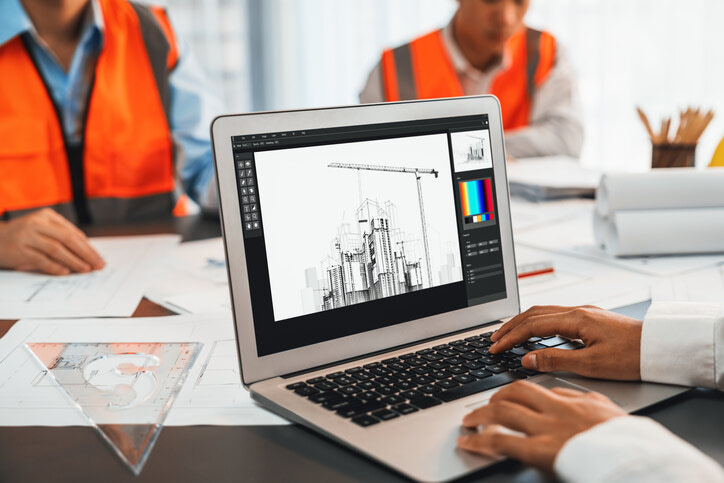
At its core, CAD drafting and design serve as the digital backbone of construction documentation. CAD software allows designers and engineers to create, modify, and visualize structures with a level of precision that manual drafting could never achieve. More importantly, it enables the integration of multiple design layers, bringing architectural layouts, civil grading plans, and structural details together into a single, coordinated framework.
This integration ensures that every dimension, elevation, and alignment is referenced from the same accurate dataset. For project managers, it provides confidence that what’s being built in the field aligns with the approved design. For surveyors and layout crews, it delivers a consistent point of reference that supports staking, verification, and quality control.
CAD as a Collaboration Tool Across Disciplines
Construction today is a multidisciplinary effort. Architects design for form and function, engineers design for performance, and contractors focus on feasibility and sequence. CAD drafting bridges these perspectives by providing a shared digital workspace where all teams can review, modify, and coordinate their input in real time.
Through layering and referencing tools, different design files, architectural, civil, and mechanical, can be viewed together, allowing potential conflicts to be detected before construction begins. For instance, a structural column may interfere with a plumbing route or electrical conduit. With CAD-based clash detection, these conflicts can be identified early and resolved digitally, saving weeks of rework in the field.
Version control is another vital feature. Instead of relying on static drawings or scattered revisions, CAD systems track every update, ensuring that all teams are working from the latest approved file. This not only improves coordination but also reduces the risk of outdated information reaching the job site.
The Benefits of CAD Drafting and Design in Construction
The impact of CAD drafting extends well beyond drawing production. It directly influences project performance in several measurable ways:
- Accuracy: Every line, dimension, and coordinate in a CAD model is based on verified data, minimizing errors and supporting precise layout in the field.
- Integration: CAD unifies design inputs across disciplines, ensuring seamless coordination between architectural, civil, and structural teams.
- Version Control: Centralized file management prevents confusion and guarantees that all stakeholders work from the most current information.
- Clash Detection: Potential design conflicts are detected and resolved early, reducing field adjustments and minimizing costly rework.
- Efficiency: Automated drafting tools and data-driven workflows accelerate drawing production and simplify revisions.
Together, these benefits streamline the design-to-construction pipeline and provide a traceable, auditable record of design evolution and decision-making.
From Digital Drawings to Field Execution
The true value of CAD drafting lies in its ability to connect digital design with physical construction. Surveyors and field teams rely on CAD-based coordinates and layouts to guide staking, alignment, and verification. When integrated with UAV mapping or 3D laser scanning, CAD drawings can be validated against actual site conditions to confirm accuracy in real time.
This digital-to-field integration helps project managers maintain quality assurance and schedule control. When every stakeholder, from design consultants to site supervisors, has access to accurate, coordinated drawings, construction proceeds with fewer disruptions and greater confidence.
To better understand how survey data supports the precision behind CAD drawings, read our next article: What Is Surveying in Construction and Why It’s Critical for Project Accuracy.
How CAD Drafting Supports Efficiency and Cost Control
Time is one of the most valuable resources on any construction project. By automating routine tasks such as dimensioning, layering, and revision tracking, CAD software reduces the manual effort required for drawing production. This efficiency not only shortens design timelines but also accelerates approval cycles and field mobilization.
Moreover, by integrating 3D modeling and data visualization, CAD drafting enhances planning accuracy and enables proactive problem-solving. When potential issues are identified before materials or labour are committed, project costs remain predictable, and productivity increases across all teams.
Precision and Collaboration Built Into Every Drawing
CAD drafting and design are far more than digital drawing tools, they are the foundation of collaboration, accuracy, and accountability in modern construction. By unifying disciplines, streamlining revisions, and linking design to real-world execution, CAD enables teams to work smarter, faster, and with greater confidence.
Reach out to Apex Geomatics Construction Surveyors Ltd. to work with a team that delivers verified boundaries, accurate layouts, and dependable data, giving your next development the precision and confidence it needs from the very start.