
Article Overview:
This article explains the critical differences between private vs public utility locates and why both are necessary before excavation begins. It clarifies what public utility locate services cover, where their responsibility ends, and how private utility locate services identify infrastructure beyond the property line or meter. The focus is on reducing strike risk, ensuring compliance, and protecting commercial and industrial construction projects from costly delays.
Excavation without verified subsurface information is one of the fastest ways to create project risk. Utility strikes delay schedules, increase liability, and expose crews to serious safety hazards. Yet many contractors and property owners assume that requesting a standard locate is enough.
Understanding the difference between private vs public utility locates is critical before any ground disturbance begins. While both fall under the umbrella of utility locate services, they cover very different infrastructure. Failing to recognize where one ends and the other begins can leave significant gaps in protection.
What Public Utility Locate Services Cover
Just as the first step in construction is a detailed site survey that establishes precise boundaries and surface conditions, recognizing the differences between public and private utility locates ensures subsurface infrastructure is mapped with equal accuracy.
Public utility locate services are typically requested through provincial one-call systems. When a locate request is submitted, utility owners are notified and dispatched to mark the approximate location of their buried infrastructure.
Public locates generally identify utilities owned and maintained by service providers, such as:
- Municipal water and sewer mains
- Natural gas distribution lines
- Electrical supply lines up to the meter
- Telecommunications lines within the public right-of-way
These locates are essential and legally required before excavation. They establish the presence of major utility infrastructure and define tolerance zones where careful digging practices must be used.
However, public utility locate services only extend to infrastructure owned by the utility provider. Once the line crosses a property boundary or passes a meter, responsibility often shifts to the property owner.
This is where confusion begins.
Where Public Locates End
The demarcation point varies by utility type, but in most cases public responsibility ends at the property line, curb stop, or building meter. Any infrastructure beyond that point is considered privately owned.
On commercial and industrial properties, privately owned utilities can be extensive. These systems are frequently undocumented or have evolved over multiple site expansions. Relying solely on public locates leaves these assets unidentified.
Utilities that are typically not covered by public locates include electrical lines that extend beyond the building meter, privately owned gas lines serving internal systems, fire suppression and sprinkler supply lines, site lighting circuits, irrigation systems, and privately installed telecom or data conduits. These systems are generally the responsibility of the property owner and require private utility locating to be properly identified before excavation.
When excavation occurs near these systems, public locates offer no protection.
Understanding private vs public utility locates requires recognizing that public services do not provide full site coverage.
What Private Utility Locates Include
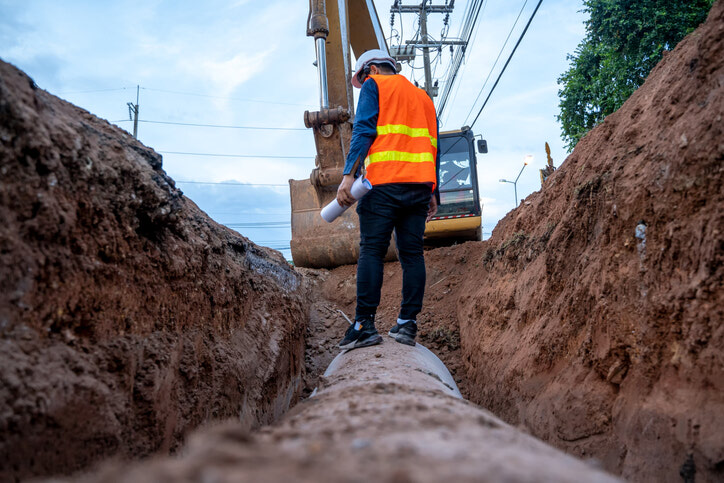
Private utility locate services are performed by specialized firms that identify buried infrastructure located on private property. These services use tools such as electromagnetic locating equipment and ground penetrating radar to detect both conductive and non-conductive systems.
Private locates are especially important during commercial site expansions, parking lot reconstruction, facility upgrades, trenching for new service installations, and industrial retrofits. In these scenarios, excavation often occurs in areas with undocumented or privately owned infrastructure, making private utility locating essential to prevent damage and project delays.
Because private utilities are often undocumented, locating them requires field expertise and systematic scanning rather than relying on utility owner records.
In many cases, private utility locate services uncover lines that were unknown to the property owner. Identifying these systems before excavation prevents unexpected strikes and costly emergency repairs.
Why the Distinction Matters for Contractors
For contractors, misunderstanding private vs public utility locates can create liability exposure.
Submitting a public locate request fulfills regulatory obligations related to utility-owned infrastructure. It does not eliminate responsibility for privately owned lines. If a contractor damages a private utility that was not identified because no private locate was performed, the contractor may still be held accountable.
Project managers and general contractors should treat public and private locates as complementary, not interchangeable.
Relying on comprehensive utility locate services ensures that all buried infrastructure is properly identified, excavation plans are based on actual site conditions, safety risks are minimized, and compliance documentation is thorough and defensible before any ground disturbance begins.
This layered approach reduces uncertainty and protects both schedule and budget.
Compliance and Due Diligence Before Excavation
Regulations across Canada require proper notification and safe digging practices before excavation. Public utility locate services are mandatory in most jurisdictions. However, compliance does not end there.
Demonstrating due diligence often requires confirming that privately owned infrastructure has also been addressed. On large commercial and industrial sites, this step is increasingly viewed as best practice.
When both public and private locates are completed, project teams can document that reasonable measures were taken to identify subsurface hazards. This documentation is valuable in the event of audits, insurance claims, or disputes.
Excavation should never proceed based on assumptions about what lies below grade.
Reducing Risk and Protecting Project Timelines
Utility strikes rarely occur because crews intentionally ignore markings. More often, they occur because a line was never identified in the first place.
By clearly understanding private vs public utility locates and engaging the appropriate utility locate services, contractors can significantly reduce strike risk.
The benefits are measurable, including fewer emergency shutdowns, reduced repair costs, lower safety exposure, improved coordination between trades, and stronger control over project schedules.
On high-value commercial projects, preventing even one strike can protect weeks of progress and significant financial investment. When utility locate data is integrated into a broader geospatial information system (GIS), it becomes more than ground markings, it becomes part of a coordinated infrastructure model that improves planning accuracy and long-term asset management.
A Practical Approach to Utility Locate Services
Before any excavation begins, project leads should confirm three steps have been completed:
Public locate requests have been submitted and markings verified on site.
Private utility locate services have scanned and identified privately owned infrastructure.
Excavation crews understand tolerance zones and safe digging requirements.
This structured approach ensures no gaps exist between public and private responsibilities.
Understanding private vs public utility locates is not an administrative detail. It is a fundamental component of responsible construction management.
Before breaking ground, ensure your project is fully protected by engaging comprehensive utility locate services that address both public and private infrastructure. Contact Apex Geomatics Construction Surveyors Ltd. for comprehensive utility locate services that cover both public and private infrastructure.